By my early twenties I was fully immersed in the comics industry - both as a reader and as a retailer. But an encounter with one of my customers lead to the discovery of a different kind of super-heroics...
1987:
The trivia:
- By 1987, the California Condor - one of the largest birds in North America - had been pushed to the very edge of extinction. Poaching, habitat destruction, and decades of lead poisoning from spent ammunition had whittled their numbers down to a mere 27 on the entire planet. Conservationists made a bold decision to help save the species - all of the huge birds were captured and placed into human care, split between the San Diego Wild Animal Park and the Los Angeles Zoo. Thanks to an extraordinary breeding program, the population slowly began to climb, until today, there are over four hundred California Condors, many living wild.
- American Airlines came up with a bold idea - sell a tiny handful of ultra-expensive unlimited first‑class tickets. No restrictions - just show up and fly anywhere in the world, anytime. It sounded like a dream - and for Chicago businessman, Steve Rothstein, it absolutely was. He bought his pass for a then staggering US$ 233,509, and over the next decade, flew more than 10 million miles, made over 500 trips to England, and took spontaneous flights just because he felt like it. Sometimes he’d book flights for strangers he met in the airport. Sometimes he’d fly somewhere simply to have lunch. Rothstein wasn’t breaking any rules. He was simply using the pass exactly as advertised, but the airline estimated his travels cost them around 21 million dollars in lost revenue. So by the mid‑2000s, they began scrutinising the few remaining unlimited ticket holders, looking for any reason to shut the program down. In 2008, they claimed they found one. Rothstein’s pass was terminated for what the airline called “fraudulent behaviour.” - his habit of booking companion tickets for people he barely knew. Whether it was truly fraud or not remains a matter of debate, but the result was the same - Rothstein's golden ticket was gone.
- 19-year old German amateur aviator Matthias Rust managed to fly his small Cessna aircraft all the way from Helsinki to Moscow and land illegally near Red Square. Despite being tracked several times by Soviet air defence, he was never shot down. Although originally sentenced to four years in prison he only served a few months and the incident allowed progressive Soviet leader Mikhail Gorbachev to dismiss many of his harshest military opponents.
Okay so I guess before I start with the memory proper, I should provide a bit more context to that comment at the top of the page about being a comics "retailer". This might take a while...
By the mid-1980s I was getting my regular comics from specialist shops rather than newsagents. It started with all those trips to "Forbidden Planet" in London, but as I left school and (after a brief period in market research) started working in Southend-on-Sea, I switched to getting my weekly fix from the local independent book shop in the historically windy Victoria Circus Shopping Centre - known rather generically as "The New Bookshop" (I never did discover where the "Old" one was).

Then to my delight, in 1985 a proper specialist comic book store opened on the bottom floor of the shopping centre. "Collectors' Dream" was run by local writer, artist, musician (and sometime shoe salesman) Gary Spencer Millidge. Gary would become well known in comic circles in later years for his seminal series "Strangehaven", but when I first got to know him, he was focused on the new shop and associated mail order subscription service - along with near-forgotten news zine "Comic News Monthly". The "Collectors' Dream" shop became the new place for us comics fans to hang out.
It was a seminal period for my favourite medium. Many of the industry's most famous and well respected titles were published then. I was there when Gary unboxed the first issues of "Watchmen" and "The Dark Knight Returns", marveling at the innovation on display. Titles such as the Giffen / DeMatteis "Justice League International", Kyle Bakers "The Shadow", the first ongoing series for Paul Chadwick's "Concrete", and so many more.
It was also in Gary's shop that we watched him work on the famine relief title that became "Food For Thought" - a charity comic that predated Marvel and DC's equivalent titles by a long way. Containing illustrations and strips by a wealth of creators old and new, it's become something of a rare item now. Luckily I still have my copy. As you can tell, we spent a *lot* of time in that basement level store - my younger brother even worked there for a while when he first left school. Those were great times. Maybe I'll write about them in more detail one day.

But at some point not long after (and here my memory gets slightly hazy), Gary decided that he needed to down-size and move the shop to smaller premises. I really wanted to get into the industry in some way and convinced my brother and a friend that we should buy the "Collectors' Dream" mail order service and run it ourselves. With a cash loan from my father, we did just that - and from my bedroom we somehow managed to run a small business on a complete shoestring.
We started with the customer list we had purchased from Gary and then expanded it by handing out flyers at the Westminster Comic Mart's. The ads looked great thanks to a custom piece of Alan Davis artwork we received with the business purchase (amazingly I still have it). Typing up the monthly order catalogues on a Commodore 64 computer, printing them out and pasting them together to then be photocopied - it would all seem incredibly primitive to modern eyes. We wrote humourous editorials to accompany the listings. Deliveries from Titan Distributors became a weekly occurrence, along with regular trips to the warehouse itself in Mile End for single issues (the minimum pre-order was two copies). All of our spare time was spent wrapping parcels, collating orders, banking cheques and keeping things afloat - all this while holding down regular jobs. It was hard work but hugely exciting. We made lot's of contacts, learnt a huge deal and of course bought a *lot* of comics for ourselves at trade prices!
We started with the customer list we had purchased from Gary and then expanded it by handing out flyers at the Westminster Comic Mart's. The ads looked great thanks to a custom piece of Alan Davis artwork we received with the business purchase (amazingly I still have it). Typing up the monthly order catalogues on a Commodore 64 computer, printing them out and pasting them together to then be photocopied - it would all seem incredibly primitive to modern eyes. We wrote humourous editorials to accompany the listings. Deliveries from Titan Distributors became a weekly occurrence, along with regular trips to the warehouse itself in Mile End for single issues (the minimum pre-order was two copies). All of our spare time was spent wrapping parcels, collating orders, banking cheques and keeping things afloat - all this while holding down regular jobs. It was hard work but hugely exciting. We made lot's of contacts, learnt a huge deal and of course bought a *lot* of comics for ourselves at trade prices!

One of our regular overseas customers was a young guy called Philip Chee who lived in Hong Kong, and he often sent us long letters with his large order, chatting about his love of science fiction and fantasy and comics. Over time we corresponded back and forth and developed a good relationship with this fellow fan who was half a world away. Then one month, Philip mentioned that he was going to be in London visiting family - and did we want to meet up with him for lunch or something?
Arranging to meet outside Tottenham Court Road tube station in the West End, the three of us waited somewhat nervously, until approached by a young dark haired gentleman in glasses. Yes, this was Philip - and after a few minutes we found ourselves getting on really well, even if he did come across as very excitable and a definite comic book expert. We made a tour of all the London comic shops within walking distance (Philip wanted to stock up on back issues) and ended up at the famous Denmark Street "Forbidden Planet" store, which as well as comics had the best selection of SF and fantasy novels in the area.

Wild Cards
It is a world parallel to our own - an Earth where an alien virus bomb strikes the Earth in the aftermath of World War II. Millions are killed, but a handful of those that survive are endowed with strange superhuman powers. Some are called 'Aces', gifted with extraordinary mental and physical abilities. Others are 'Jokers', cursed with grotesque mutations or unpredictable quirks. Some turn their talents toward helping humanity, others toward harming it. And from that simple premise the Wild Cards 'shared universe' was born.
On the surface, it might sound like a prose version of the Marvel or DC universe. But the difference was the “mosaic novel” format. Each character was created and written by a different science fiction author, but all their stories interlocked into a single, coherent narrative. The whole thing was shepherded by some guy I’d never heard of called George R. R. Martin (wonder what happened to him ?). These weren't your traditional throwaway stories either. Following the 80s trend towards more realistic portrayals of super-heroes, these characters were fully three dimensional - they changed and adapted and faded in out out of the narrative like real people and even died, sometimes in sudden, violent ways.
The roster of 80s writers was astonishing - Walter Jon Williams, Roger Zelazny, Melinda M. Snodgrass, Stephen Leigh, Daniel Abraham, and many more. Even legendary X‑Men writer Chris Claremont contributed. It felt like a clubhouse of genre heavyweights all playing in the same sandbox. The first volume chronicled the events from World War II to the (then) present day showing the emergence of the Aces and Jokers and the impact they had on world history. It also sprinkled in delightful alternate‑history cameos - Mick Jagger as a werewolf, Jim Morrison as the literal Lizard King, and so on. More importantly, it introduced the characters who would become the backbone of the series:


Tor’s run quickly grew into its own era. "Busted Flush" and "Suicide Kings" completed the “Committee Trilogy,” a storyline that pushed the universe into geopolitics, humanitarian crises, and the messy reality of superpowered interventionism. After that came a steady stream of new volumes - each one expanding the mythology, exploring new corners of the world, or revisiting long‑running characters in surprising ways. The tone ranged from noir to horror to political thriller to cosmic weirdness, to reality TV - but it's always felt unmistakably "Wild Cards".


Honourable mentions:


- Doctor Tachyon - a flamboyant Takesian who tried to prevent the detonation of his races virus bomb and now attempts to atone for their mistake.
- Croyd Crenson "The Sleeper" - cursed to fall into a coma and wake up in a new body every few months. Sometimes an Ace and sometimes a Joker, he never knows what will happen when he falls asleep.
- The Great and Powerful Turtle - possessed of the world most powerful mental abilities, he hides inside a metal shell constructed from an old VW Beetle
- Fortunato - the supreme sorcerer on the planet who recharges his powers via tantric sex.
- Captain Trips - a burned out hippy biochemist who can call forth five different super-powered persona through the use of designer drugs.
- Puppetman - a politician able to control the minds of anyone he touches and feed off their negative emotions? What could possibly go wrong?
I devoured the first book and immediately went back and brought the following two. Set in the late 80s, each one dealt with a particular threat, but sub-plots and continuing threads were interwoven and carried between all three. It got better - between 1987 and 1993, twelve books were published, spanning political thrillers, detective mysteries, space opera, and everything in between. A whole world of different heroes and villains were introduced and like the best comics multi-part stories, it took several volumes for all the events to unfold. Sometimes the heroes won. Sometimes they lost and people died. It was my comics world seen through an adult lens - violent, sexy, horrific, thoughtful, and utterly addictive.
Around book six, a UK publisher (I’m fairly sure it was Titan) caught onto the "Wild Cards" phenomenon and reissued the series with new Brian Bolland covers. US publisher Bantam Spectra responded with their own new covers by "Grimjack" artist Timothy Truman and it's those that adorn my copies of books seven to twelve.


Then came a shift. With volume 13, "Card Sharks", a new trilogy began - and a new publisher, Baen, took over. Barclay Shaw replaced Truman as cover artist. Released just a month after book 12, the book kicked off a conspiracy arc involving a deadly “antidote” to the Wild Card virus known as the Black Trump. The trilogy also wrapped up several long‑running character arcs and felt like a natural endpoint. For a while, it seemed like the series might be finished.
Seven years passed.
Then, in 2002, came "Deuces Down", published by iBooks - the long‑awaited sixteenth volume. It echoed the structure of the first book, offering standalone stories across four decades. But this time it focussed on those less well known members of the Wild Card saga - the “Deuces”, people with minor, often inconvenient powers. It was fun, but I was hungry for the main timeline again.
Four years later, I got my wish with Death Draws Five, a solo novel by John J. Miller. An apocalyptic thriller with religious overtones, it brought back favourites like Carnifex, Mr. Nobody, and Fortunato, and introduced the formidable Midnight Angel. But iBooks collapsed into bankruptcy, and once again the series needed a new home.
Enter Tor Books, who didn’t just rescue Wild Cards - they revitalised it. Beginning in 2008 with "Inside Straight", Tor introduced a new generation of Aces and Jokers, a new global scope, and a new wave of writers joining the "Wild Cards Trust". It wasn’t a reboot (the series has never had one), but a widening of the lens. The old guard still appeared, but now they shared the stage with younger, stranger, more diverse characters shaped by the 21st century.

The publisher also embraced the digital age. A whole run of standalone short stories and novellas appeared on Tor.com. Self‑contained, often free to read, they sometimes tied into or foreshadowed events in the main novels, but also worked as little snapshots of life in the Wild Cards universe. For long‑time readers, they feel like bonus tracks - for newcomers, they were an easy way to dip a toe into the world without committing to a full novel.

Meanwhile, Tor began reissuing the original Bantam books - some with new introductions, some with additional stories, and all with a consistent design that finally made the sprawling series feel unified on the shelf. For new readers, it was the perfect jumping‑in point. For old readers like me, it was a chance to revisit the classics with a fresh coat of paint.
Then, in 2023, the series did something unexpected - it returned to its original publisher, Bantam Books. For the first time since the early 90s, new Wild Cards novels were once again appearing with the Bantam logo on the spine. Tor’s final major contribution came two years later with "Aces Full", a second volume of its previously online‑only stories.
The Wild Cards universe has become something rare in genre fiction - a shared world with nearly four decades of continuous, unbroken history, spanning more than thirty books and multiple publishers. No reboots. No continuity wipes. No “multiverse resets". Just a living, evolving timeline shaped by dozens of writers and hundreds of characters. Sure regular superhero comics have caught up with some of the storytelling techniques used ("Astro City" springs to mind), but there is still something unique about the novels and the world.
Turning things almost full circle, there have actually been several comic mini-series telling original stories. Recently Bantam even branched out in graphic novels (although I have to say the new US cover designs are bloody awful). Plus there have been role playing games, audio books and translations into different languages. There (predictably) was even a live action TV show in development at one point.

I've bought all the books avidly since that original chance recommendation from young Philip Chee - and perhaps that's really why I love them. Because they’ve grown up alongside me. They’ve changed, taken risks, reinvented themselves, and refused to stand still - just like the best long‑running stories do. Every new volume feels like catching up with old friends, but in a world that’s still full of surprises. After nearly forty years, "Wild Cards" remains unpredictable, ambitious and utterly alive - and I can’t think of another shared universe that’s earned my loyalty the way this one has.
And the remarkable thing is - it’s still going. New books, new characters, new directions. The "Wild Cards" universe looks certain to continue for many years to come - and I can't wait to find out what happens next.

Honourable mentions:
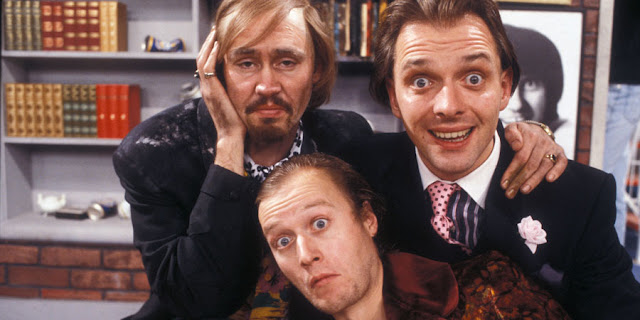
- Filthy, Rich and Catflap - a comedy series that's only six episodes long, is barely remembered by the mainstream - yet is absolutely essential if you want to understand the evolutionary chain that runs from the anarchic brilliance of "The "Young Ones" to the full‑tilt slapstick carnage of "Bottom". Rik Mayall plays Richie Rich, a talentless, delusional, permanently unemployed actor whose ego is so inflated it might as well have its own postcode. Nigel Planer is Ralph Filthy, the sponging, sleazy, morally flexible agent who’d sell his own mother for a 10% cut. And Adrian Edmonson is Edward Didgeridoo Catflap, Richie’s violent, drunken minder - a man who treats the world like a pub brawl waiting to happen. So far, so familiar. But the twist is that the show treats the' Fourth Wall' like a suggestion. Characters wander in and out of the studio audience, mock the production, and generally behave as if reality is something that happens to other people. It’s meta before that was a buzzword, and is gleefully rude about the Z‑list celebrity culture of the time. And yet, for all its energy, it never quite hits the same delirious heights as "The Young Ones". Maybe it’s the showbiz satire, maybe it’s just that the characters are totally unsympathetic. Despite that it’s still absolutely worth watching for the sheer manic commitment of the performances. It’s messy, loud, self‑aware, and gloriously unhinged.

- Green Arrow The Longbow Hunters - After the shockwave of "The Dark Knight Returns", this was DC’s second big “prestige format” gamble - a mandate to take a second tier character somewhere deeper, darker, and more human. I already knew Mike Grell from "Jon Sable, Freelance", where he’d honed that grounded, muscular, street‑level style. But what he did here was on another level. It wasn’t just a new coat of paint on Oliver Queen - it was a complete reimagining of who the character could be. Grell stripped away the trick arrows and the cartoonish villains. He acknowledged Oliver’s age and his scars. He dropped him into a world of serial killers, organised crime, and moral ambiguity. Suddenly Green Arrow wasn’t a superhero - he was an urban hunter. And that shift worked. It made me care about a character I’d never been particularly invested in before. Grell’s Seattle was moody, rain‑soaked, and lived‑in. His action scenes had weight. His violence had consequences. Even the relationship between Oliver and Dinah Lance felt more adult - messy, complicated and believable. The three issues were a mission statement which paved the way for Grell’s seven‑year run as writer (and occasional artist), a stretch that remains one of the most consistent and character‑defining eras any DC hero has ever had. For my money, "Longbow Hunters" is still one of the finest Green Arrow stories ever told.

- Weaveworld by Clive Barker - I never got into the"Books of Blood" or the "Hellraiser" movies. Horror stories are not really my thing and certainly in 1987 I had read only a mere handful of that type of novel. However I picked up "Weaveworld" because of the more fantasy-orientated premise - and boy was I glad I did. The book revolves around the secret existence of a race of magical beings known as the "Seerkind" and their struggles to remain hidden from the non-magical world inside "The Fugue" - a separate dimension woven into the strands of a carpet. The Seerkind have to face multiple dangers from human and non-human antagonists, plus the mysterious "Scourge" which seeks to destroy all magic. Full of religious allusions and themes, a multi-facted plot and truly evil and horrific threats, the novel was several worlds away from the more traditional fantasies I had consumed up to that point. I quickly became a Barker devotee as he published one excellent novel after another over the next ten years. Any attempt to turn "Weaveworld" into a film or TV series can only be doomed to fail in my eyes, as it would be practically impossible to match the imagination and power of Barker's prose.

- The New Statesman - It's Rik Mayall again in a razor sharp political comedy. What's not to love? As Tory M.P. Alan B'Stard he was selfish, devious, lecherous and utterly without shame - a man who treated service to the British public like an inconvenience. Heaven help anyone who got in his way, and whatever schemes, crises or scandals surrounded him, B'Stard always came up as top dog, usually with a smirk and a cheque in his pocket. It was a role tailor‑made for Mayall - all swagger, venom, and sarcastic brilliance - and it proved what some of us already suspected: that he wasn’t just a great comedian, he was a genuinely tremendous actor (I'm biased - I already considered Rik to be my comedy god). The show was savagely funny. Cruel, irreverent, and gleefully disrespectful to anyone in power. No party was safe. If you were a politician, B’Stard was coming for you - and any resemblance to real figures, living or dead, was absolutely deliberate. His toxic charm ran across four series, two specials, stage shows, and even newspaper columns and looking back, it’s astonishing how much of the show still feels relevant. Maybe that’s because politics hasn’t changed as much as we’d like to think. Or maybe it’s because Rik Mayall, in full B’Stard mode, tapped into something timeless - the idea that power attracts the worst people, and the only sane response is to laugh at them as loudly as possible.

- The Question - Another reimagining of a lesser DC character - but this time it's the faceless vigilante from Steve Ditko, a hero originally steeped in it's creators objectivist absolutism. But Denny O’Neil and Denys Cowan didn’t just update The Question - they rebuilt him. Vic Sage became a flawed, curious, introspective figure, wrestling with morality, identity, and the limits of black‑and‑white thinking. O’Neil infused the series with Eastern philosophy, Zen teachings, and a deep sense of moral ambiguity. The series wasn’t afraid to just let Vic meditate, question his own motives, or simply observe the world around him. It was a superhero comic that felt more like an philosophical detective novel that just happened to involve masks. These weren't distinct adventures - it was an ongoing saga, with the final issue referencing points made all the way back in the first. Sure there were mysteries, fights, conspiracies, and some genuinely great supporting characters - but the heart of it was always Vic Sage’s internal journey - the idea that the real battle was against your own self. Denys Cowan’s art was a perfect match for the book’s tone. His version of Hub City felt like a feverish, corrupt, rain‑soaked nightmare, a place where justice was always out of reach and the shadows had shadows of their own. For me it remains one of the most thoughtful, mature, and quietly daring superhero books DC has ever published. A quiet masterpiece.

- Star Trek Next Generation - We actually didn't get to see this show in the UK until September 1990, when it started airing in that cosy early evening slot on BBC2, but I've included it here as it was first broadcast in the USA in 1987. It came at exactly the right time for me. "Doctor Who" had finished the previous December and into that gap sailed the Enterprise‑D, all gleaming curves, diplomatic missions, and Jean‑Luc Picard’s magnificent bald head. I latched onto it instantly and it became my new favourite genre show. Thanks to some 4 hour VHS tapes and my trusty 'long play' Panasonic video recorder, I managed to cram up to eight episodes on one cassette. In later years this meant that my first wife and I (also a fan) would occasionally start watching an episode in bed, fall asleep and wake up the next morning to find that Captain Picard was still boldly going, having spent the night exploring strange new worlds while we snored! For a while I was obsessed with all things "Trek" and amassed a large collection of books, comics, fact files and assorted ephemera. Even if that obsession has faded and even if it doesn't quite reach the heights of "Deep Space Nine" in terms of dramatic arcs and long-form storytelling, "TNG" still has a cast of characters that I love to spend time with. It's one of those rare shows where despite having seen each episode so many times that I probably know the plots off by heart, when one comes on the TV I still stop changing channels and start watching. Engage!

- Marshal Law - First published by Epic Comics as a six-issue mini, before sporadically hopping around a number of different publishers and formats in the subsequent years, Pat Mills and Kevin O'Neill's savage satire of the superhero genre is a classic that deserved a much wider audience. Set in the future sprawl of San Futuro, the titular character is a government‑sanctioned hero‑hunter, whose job is to take down rogue superhumans with maximum force and minimum sympathy. He hates superheroes. He hates himself for being one - and Mills uses that as a scalpel, slicing into every major comic‑book archetype with savage glee. Over the course of the various storylines, no icon is safe. If you’ve ever worn a cape, Mills probably eviscerated you. It's a flamethrower aimed at the idea that superheroes are noble, pure, or even remotely sane. Match that with Kevin O'Neill's unique, grotesque spiky artwork and you have something really rather special. Later crossovers - with The Mask and even with Pinhead from Hellraiser - are odd little curiosities. Less acerbic, but still fascinating in that “I can’t believe they actually published this” way. They’re proof of how elastic the character was, how easily he could be dropped into other universes and still feel like the most dangerous thing in the room. If you’ve never read it, there’s a big deluxe collection out there, and it absolutely deserves a place on your Christmas list. "Marshal Law" is one of those cult classics that should have been huge - a blistering satire, a visual feast, and a reminder that sometimes the best way to work in a genre is to set fire to it.

- Max Headroom - Trying to explain Max Headroom to anyone who didn’t live through the mid‑80s is a bit like trying to describe a fever dream. “He was the world’s first computer‑generated TV star… sort of.” “He hosted a music‑video chat show.” “He advertised New Coke.” “He was in a pop single with Art of Noise.” “He had his own cyberpunk drama series.” All of these things are true, and yet none of them quite capture how omnipresent he was. For a few years, Max wasn’t just a character - he was a cultural phenomenon. Born from a one‑off British TV drama, Max Headroom was played by Matt Frewer under layers of prosthetics and video trickery, delivering lines in a stuttering, glitchy voice that became instantly iconic. He looked like a computer simulation, sounded like a malfunctioning AI, and behaved like a caffeinated talk‑show host who’d been left alone with too much electricity. And somehow, it worked. The drama was great, but my favourite incarnation was the US TV series. Set in a dystopian near future (aren't they all?), it imagined a world where television networks ruled everything - politics, culture, information, even law enforcement. It was stylish, inventive, and surprisingly sharp for its time, tackling media exploitation, corporate power, surveillance, and the manipulation of truth. Watching it now is a strange experience since so many of the things it predicted have sort of come true. What once felt like satire now feels uncomfortably close to the evening headlines. The show was weird, clever, anarchic, and utterly of its moment - and yet somehow still relevant. "Twenty minutes into the future" never felt so close...

Star Cops - This little SF show arrived with ambition, intelligence, and a grounded approach to space drama decades ahead of its time - and then promptly vanished under the wheels of scheduling chaos and BBC indifference. The premise was simple - in the near future, humanity has begun to spread into orbit and onto the Moon, and with that expansion comes crime. Smuggling, sabotage, espionage, even murder. Enter the International Space Police Force - the “Star Cops” - a small, underfunded, politically beleaguered team trying to keep order in an environment where one mistake can kill you. What made it special to those of us who loved it was the tone. This wasn’t glossy space opera. It was procedural science fiction, grounded in physics, bureaucracy, and the messy reality of human behaviour. The tech felt plausible. The politics felt depressingly familiar. And the characters - especially David Calder’s wonderfully grumpy Nathan Spring - felt like actual people doing an impossible job. Sure the effects and the weightless scenes are bit shonky, and the theme tune by Justin Hayward widely derided (except by me), but the whole show has a real intelligent charm. It treats its audience with respect. The tragedy is that "Star Cops" never got the chance it deserved and it struggled to find an audience. Only nine episodes were ever made - and yet it left a mark. It's a clever, thoughtful gem that pointed the way toward the kind of grounded sci‑fi storytelling we’d later see in things like "The Expanse", and it remains a show that is really special to me. Thankfully in more recent years Big Finish have picked up the baton, and continue to produce audio stories with many of the original cast members. Amazingly they genuinely feel like the TV episodes we never got to see. If we ever do get a base on the Moon, we have to remember that "it won't be easy"...
